|
Life in the skin of a bubble
Around our planet wraps an exquisitely thin film of air and water,
inside which exists all the life we know. The planet is eight thousand
miles wide, the film of air and water is just a few miles thick,
and outside it is the cold vacuum of space.
Conditions in the life-supporting film have
rather suddenly started changing. The air is heating, and the ocean
is acidifying.
Both trends are caused by increasing
quantity of carbon dioxide gas in the atmosphere. That extra gas
is being pumped into the atmosphere by us.
Temperature
These are the estimates by climate scientists (based on many kinds
of measurement) for the global air temperature, the average
temperature of the atmosphere above all lands and seas. (In degrees
Celsius; to convert to Fahrenheit, multiply by 1.8 and add 32.)
A seemingly small difference such as 0.1° C implies a vast amount
of extra heat in the air.
13.6°: approximate level in 1850.
13.66°: mean for 1850 to 1899.
13.75°: same for 1900 to 1960.
13.97°: same for the 30-year period 1961-1990 (usually quoted
as roughly 14°, and being used as a baseline for many figures
now given).
14.24°: same for the decade 1990-1999.
14.42°: same for 2000-2008. (About 0.75° above the 19th-century
level.)
15.6° (about 2° above the 19th-century level): the
highest possibly safe point, or more realistically the tipping
point which it would be folly to reach: global temperature at
which there would be a 50-50 chance of preventing runaway heating.
Others (such as the governments of several nations already harmed
by rising oceans) would rather set this safe limit 0.5° lower.
20° (6° or 7° above the 19th-century level): probable
level reached in the 21st century if present trends (middle estimate)
continue.
This is a graph by years from 1850 to 2008. Actually
it shows not the absolute temperatures (which I think easier to
understand) but the “anomaly”or difference from the 1961-1990
average. The black curve is for the mathematically “smoothed”values.
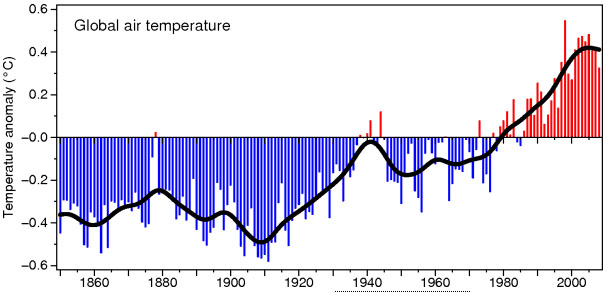
Graphs like this show a general trend, but also many smaller-scale
up-and-down jags, due to secondary factors, such as volcanic eruptions,
which can cause cold years by putting dust into the upper atmosphere.
These are the 20 hottest years of the more than a century
and a half on record.
1998 14.546°
2005 14.482°
2003 14.473°
2002 14.464°
2004 14.447°
2006 14.422°
2001 14.409°
2007 14.405°
1997 14.351°
2008 14.325°
1999 14.296°
1995 14.275°
2000 14.270°
1990 14.254°
1991 14.212°
1988 14.180°
1987 14.179°
1983 14.177°
1994 14.171°
1996 14.137°
It is striking that these include every year from 1994 onward.
And not one from before 1983.
Acid in the ocean
The graph of global heating has been going up in step with the graph
of atmospheric carbon dioxide, though roughly, because jags in the
graph are caused by lesser factors, such as volcanos and world wars.
So there is room for some argument about the details.
But the graph of ocean acidity goes up exactly
in step with the increasing carbon dioxide. It has to. Carbon dioxide
in contact with water dissolves into it and forms carbonic acid.
More carbon dioxide, more carbonic acid. We know how much more carbon
dioxide gas we are generating, we can predict how much more acidity
that will cause, we can measure the pH (acidity) of the oceans,
and it keeps to prediction.
There is no room for argument about it.
And so there is no room for valid doubt about the whole linked pattern.
Human activity has reached a scale at which it is corroding the
thin film in which we, and other creatures, live.
Increasing acidity prevents calcium carbonate
from forming in the water. Calcium carbonate is used to make the
shells of corals, molluscs, and plankton. Plankton are the base
of the marine food-chain. Coral reefs, the "rainforest of the
ocean", cover only one percent of ocean area but support a
quarter of all ocean species, and they are already being destroyed
by human activity such as fishing with dynamite, as well as by warming
water. If the acid in the oceans keeps increasing at its present
rate, it will not only hinder formation of calcium carbonate but
dissolve it. Alarmingly large areas of coral reefs have already
gone white, as dead as bones.
(Actually ocean acidity goes up somewhat
faster than aerial carbon dioxide: rivers add the acid rain caused
by power plants; they also add fertilizer runoff from farms, which
cause algal blooms, which decay into carbon dioxide directly in
the water.)
Is there now a change to cooling?
Some say that since there was a peak in 1998 the planet must have
reverted to a cooling trend. But this is an instance of a shorter-term
jag. There are two oceanic phenomena, called “El Niño”and
“La Niña”, that add to or subtract from the general
trend. They bring warm and cool currents, respectively, to the eastern
Pacific and have world-wide effects on weather. The 1998 El Niño
was the strongest on record and added to global heating. It was
followed by a La Niña that brought some cooling. Another
El Niño began in mid 2009 and will probably continue at least
into early 2010.
Even though this El Niño is far weaker
than the 1998 one, 2010 will probably exceed the 1998 record and
be the hottest year ever recorded: 14.58° C. This is the prediction
(Dec. 10, 2009) of the United Kingdom's Met Office, which gives
it a more than 90% probability, not a certainty, because the El
Niño could end sooner or volcanic eruptions could have their
usual cooling effect.
It's cold here! — where's Global Warming
when we need it?
The January 2010 temperatures were well below normal in most of
the USA, the British Isles, Scandinavia, and especially northern
Russia and Siberia.
But they were well above normal in most
of Europe, central Asia, North Africa, the Middle East, and Canada.
(Vancouver had its warmest January ever, so that snow had to be
trucked and helicoptered in for the winter Olympics.) This is an
instance of deceptive local variation. Globally, this January was
the second warmest on record.
Ice and snow
Glaciers in many parts of the world have been retreating, the Greenland
and Antarctic ice sheets are shrinking. The winter ice cover on
the Arctic Ocean is becoming smaller year by year — threatening
the survival of polar bears. White ice reflects the sun's heat back
into space whereas dark water absorbs it, thus increasing the heating
and the melting — an obvious feedback loop.
Ice and snow on the Himalayas ars rapidly
dwindling. Photographs of mountain ranges taken in 1968 and 2007
show glaciers shrunken and the snow line hundreds of feet higher.
The glaciers of the Himalayas are the sources of the great rivers
that supply water to the Indian subcontinent, southeast Asia, and
China — an enormous fraction of the world's population.
In Ladakh (“Little Tibet”, the
northernmost part of India) most farmers depend on runoff water
from glaciers. Average temperatures have risen by 1C in winter and
5C in summer from 1973 to 2008, less snow falls and it disappears
more quickly, so glaciers and irrigation water are disappearing.
A local engineer has been meeting a little of the farmers' desperation
by making “artificial glaciers” (in winter the water in
some pipes is allowed to keep running, though not needed, to stop
it from freezing; instead he lets it out through holes to freeze
on north-facing hillsides, thus saving it for the summer).
Mistake on page 493
The Intergovernmental Panel on Climate Change was set up by the
United Nations in 1988 to evaluate research done around the world,
mainly using peer-reviewed articles in the scientific literature,
and from 1990 onward it has published four massive reports and many
supplementary ones.
But it's all nonsense! It includes a mistake.
On page 493 of the 976 pages of the second
of the four volumes (totaling more than 3000 pages) of the IPCC's
Fourth Assessment Report, 2007, there is an estimate that Himalayan
glaciers are melting fast enough to disappear by 2035. This estimate,
based on information from the World Wildlife Fund about difficult
measurements of these debris-strewn glaciers, was soon retracted,
by the IPCC and by the WWF. It had been caught by Professor Graham
Cogley of Trent University in Ontario, who
said: "The reality in the Himalayas is bad enough without exaggerating
it. The glaciers are losing mass and we are fairly sure they are
losing mass faster now than a few years ago. We also know that the
Himalayan glacier water could become a non-renewable resource."
The mis-estimate was seized on by global-heating
deniers and labeled "Glaciergate" — as if it will be fine for
the glaciers to disappear and the Ganges, Mekong, and Yangtze to
run dry a few decades later.
And there is at least one other mistake:
the percentage of the Netherlands below sea-level was said to be
55; this figure, which had been provided by the Dutch government,
should have been 26, as the IPCC and the Dutch government soon stated.
And there have been mistakes in the opposite
direction. IPCC reports have given estimates for the speed of disappearance
of Greenland and Antarctic glaciers and the Arctic ice cap, and
the rise of sea levels, which are proving to be too low.
Deniers avoid mentioning this.
In many thousand pages of carefully detailed
science, it would be surprising if there were not a mistake. To
say that it invalidates the whole and shows that global heating
is not happening is like saying a car won't run because someone
left a speck of dirt on the right rear window. Or, to use another's
metaphor (Luke 6:42): "Hypocrite, first remove the beam from your
own eye, and then you will see clearly to remove the speck from
your brother's eye."
A conspiracy — on
which side?
Much of the solid research used by the IPCC was done by the three
or four researchers of the Climatic Research Unit of the University
of East Anglia, at Norwich, directed from 1998 by Professor Phil
Jones. The CRU became bombarded with questions from the public.
I didn't know this when I sent a question, to which I got a courteous
reply. Many of the questions were hostile and "makework" —
designed to waste the scientists' time — and provoked some
natural impatience, which the scientists expressed in emails to
each other. Hackers broke into the CRU's computers, stole hundreds
of private emails, and selectively leaked them to the internet —
timing this for the eve of the December 2009 Copenhagen Climate
Conference, with obvious intent to cripple it.
The stolen and misrepresented emails were
trumpeted as "Climategate", the uncovering of a conspiracy among
climate scientists to withhold evidence against their conclusions.
It did play a large part in the failure of Copenhagen. Phil Jones
admitted that he contemplated suicide.
Who were the real conspirators? They remain — unlike
the scientists they boobytrapped — in hiding. (There has been
a suggestion that they worked, like other hackers, from Russia.)
No one has a love for climate disaster, a motive to pretend that
it is looming; there are certainly those who have a vested interest
in pretending that it isn't.
An inquiry by the cross-party Science and Technology Select Committee
of the House of Commons reported in March 2010 that there was no
case against Jones for him to answer, and that he should return
to the post from which he had stepped down. In April another investigation,
by an independent panel of leading professors from the US, Britain,
and Switzerland, chaired by Lord Oxburgh, rector of the Imperial
College London, utterly exonerated the scientists. " . . . absolutely
no evidence of any impropriety anywhere . . .
all of the conclusions were honest and sensibly arrived at . . .
the work has been carried out with integrity, and allegations of
deliberate misrepresentation and unjustified selection of data are
not valid . . . no hint of tailoring results
to a particular agenda . . . We saw no hint
of deliberate scientific malpractice in any of the work of the CRU . . . "
One of the investigators, Prof. David Hand, commented:"There is
no evidence at all of anything underhand, the opposite if anything,
in that they have brought out in the open the uncertainties associated
with what they are doing." The CRU scored, as it were, 98 out of
100; the slight criticisms by these investigators were that the
CRU could have used some more recent statistical methods, and that
climate scientists in general should be a bit more willing to release
masses of their primary data, even to those obviously demanding
it in hope of undermining their work.
"Hackergate" has uncovered the sneakery
to which anti-scientists will stoop. It has done nothing to discredit
the huge body of evidence that global heating is real and is human-caused.
Geo-engineering
Some suggest that, because we are failing to stave off disaster
by curbing carbon emissions, we should turn to drastic technologies:
—Reduce the sun's in-coming energy by lofting
into the atmosphere mirrors, or sulfate particles, or salt crystals
from the sea, which would cause brighter clouds to form
—Or fertilize the ocean with
iron in the hope that it will absorb carbon dioxide faster.
—Or (probably the most hopeful) extract
carbon dioxide from the atmosphere, and store it underground or
use it for fuel.
The first problem is the “law of unintended
consequences”. Thus the salt-crystal-spraying idea was regarded
as the most promising, until in 2010 scientists found it could actually
have the opposite effect by interfering with natural processes.
However, if these methods led to some disaster
they could be discontinued. But that raises the second and greater
problem. Any such method would all too likely divert attention,
funding, and research away from solving the root problem. Emissions
would continue, there would be an even greater quantity of carbon
dioxide in the atmosphere, and if the geo-engineering effort failed,
or was not maintained, heating would suddenly resume at an overwhelmingly
increased rate.
The successful precedent: the ozone "hole"
Life on earth is shielded from most of the sun's ultraviolet radiation by an ozone-containing layer at a height of around 20,000 feet. (Ozone molecules are made of three oxygen atoms; there is one ozone molecule to about 100,000 other molecules in the surrounding air.)
Industrial chemicals, especially halons and the chlorofluorocarbons used in refrigerators and spray cans, rise and destroy the ozone. That this was happening became suddenly clear in 1985 when laborious measurements made by three researchers at the British Antarctic Survey's Halley station showed that over Antarctica, where special conditions in spring hurry the process, ozone had thinned by 40 percent in a decade. The discovery nearly didn't happen: the Conservative government of Mrs. Thatcher was busy cutting funds for science like this.
Scared by the prospect of blinding eye cataracts
and fatal skin cancers, the world agreed in 1987 to the Montreal
Protocol, which would phase out ozone-destroying chemicals.
By 2009 all UN members had signed, and production of those chemicals
has dropped by 95 percent. The "ozone hole", which had looked like
spreading across the world, has not gone away, nor have the ozone-destroying
gases, but they have leveled off and the layer may recover by 2100.
Unfortunately the chemicals and some of those used to replace them
are also greenhouse gases, up to 10,000 times more so than carbon
dioxide.
Still, the Montreal Protocol has been called
"the most successful international environmental agreement". It
shows that we can do it.
Some readings
—Text of an article from
a region where global heating is starkly visible. The permafrost
across Siberia and northern North America is thawing and releasing
huge jets of methane (25 times more effective as a greenhouse gas
than carbon dioxide). Look at the plea in the last paragraph.
—Text of an article from just
after the shamefully feeble end of the Copenhagen summit climate
conference, calling for citizen action.
—Text of an article about
a transformation of our way of raising food, which would have advantages
for the natural world and would reduce carbon dioxide emission,
if only it could be adopted quickly and widely.
|